


We’ve all had the experience of talking to someone who seems present, but somehow isn’t really listening.
Maybe they interrupt before you finish your sentence. Maybe they’re already preparing advice while you’re still speaking. Maybe they nod along, only to pivot the conversation back to themselves moments later.

In moments like these, the conversation may continue, but the connection often doesn’t. Instead of feeling understood, we leave feeling unheard, dismissed, or emotionally alone.
The difference between listening to respond and listening to understand may seem subtle, but it shapes the emotional experience of every relationship we have. One creates defensiveness, misunderstanding, and distance. The other creates safety, trust, and genuine connection.
Let’s understand this distinction, how it shapes emotional connection in relationships, and how Relational Life Therapy helps couples build healthier communication through deeper listening and understanding.
What Does “Listening to Respond” Actually Look Like
Listening to respond happens when our attention is focused primarily on what we are going to say next.
Sometimes that response is defensive. Sometimes it’s advice-giving. Sometimes it’s an attempt to fix, explain, or prove something.
This type of listening often appears in conversations through behaviors such as:
- Interrupting or finishing someone’s sentences
- Mentally rehearsing your reply while they’re talking
- Offering solutions before fully understanding the issue
- Shifting quickly into your own story or perspective
- Listening for points of disagreement instead of emotional meaning
In couples and families, this dynamic can become chronic. Conversations start feeling transactional instead of relational. People stop feeling emotionally connected.
How “Listening to Understand” Happens in Relationships
Listening to understand begins with curiosity rather than self-protection. When someone feels genuinely listened to, they stop feeling like they have to fight to prove their emotions are valid. The conversation becomes less about defending positions and more about understanding the experience beneath the words.
Often, what people need most is not immediate advice or reassurance. They need space for their feelings, perspective, and emotional reality to be fully heard before the conversation moves toward solutions.
This kind of listening does not require agreement. It requires presence. It allows people to feel heard without immediately being corrected.
Why People Struggle to Listen Deeply
Most people are not intentionally trying to dismiss others. Often, listening breaks down because of emotional habits, stress, defensiveness, or a lack of awareness during conversation.
Some of the most common barriers to deep listening include:
- Emotional Defensiveness: Many people listen through the lens of self-protection. When they hear disappointment, frustration, or criticism, they may immediately begin defending themselves instead of trying to understand the other person’s experience.
- Wanting to Fix the Problem Quickly: Some people rush into advice or solutions because emotional discomfort feels hard to sit with. Instead of slowing down to fully hear the feelings beneath the surface, they try to “solve” the conversation as fast as possible.
- Fear of Being Wrong: Listening deeply sometimes requires acknowledging another person’s pain or perspective. For some individuals, this can feel like admitting failure, blame, or inadequacy, which makes genuine listening difficult.
- Growing Up Without Healthy Communication Models: Many people were never taught how to listen emotionally. If someone grew up in environments where feelings were dismissed, interrupted, criticized, or avoided, they may unconsciously repeat those same patterns in adult relationships.
Learn How RLT Addresses Generational Trauma.
- Emotional Overwhelm: During emotionally charged conversations, the nervous system can become flooded with stress, anxiety, shame, or anger. When this happens, staying calm and present becomes much harder.
- Distractions and Mental Overload: Stress, exhaustion, phones, multitasking, and constant stimulation can make it difficult to give someone full emotional attention. Sometimes people hear the words without truly understanding the emotional experience behind them.
- Difficulty Tolerating Vulnerability: Deep listening requires emotional presence. For some people, vulnerability can feel uncomfortable or unfamiliar, so they may avoid emotional depth by joking, changing the subject, or withdrawing emotionally.
- Lack of Curiosity: Healthy listening begins with curiosity. When conversations become focused on proving a point, winning, or being “right,” genuine understanding usually disappears.
Also Read: Power of Curiosity in Strengthening Relationships
Listening to Understand vs Listening to Respond in Everyday Relationships
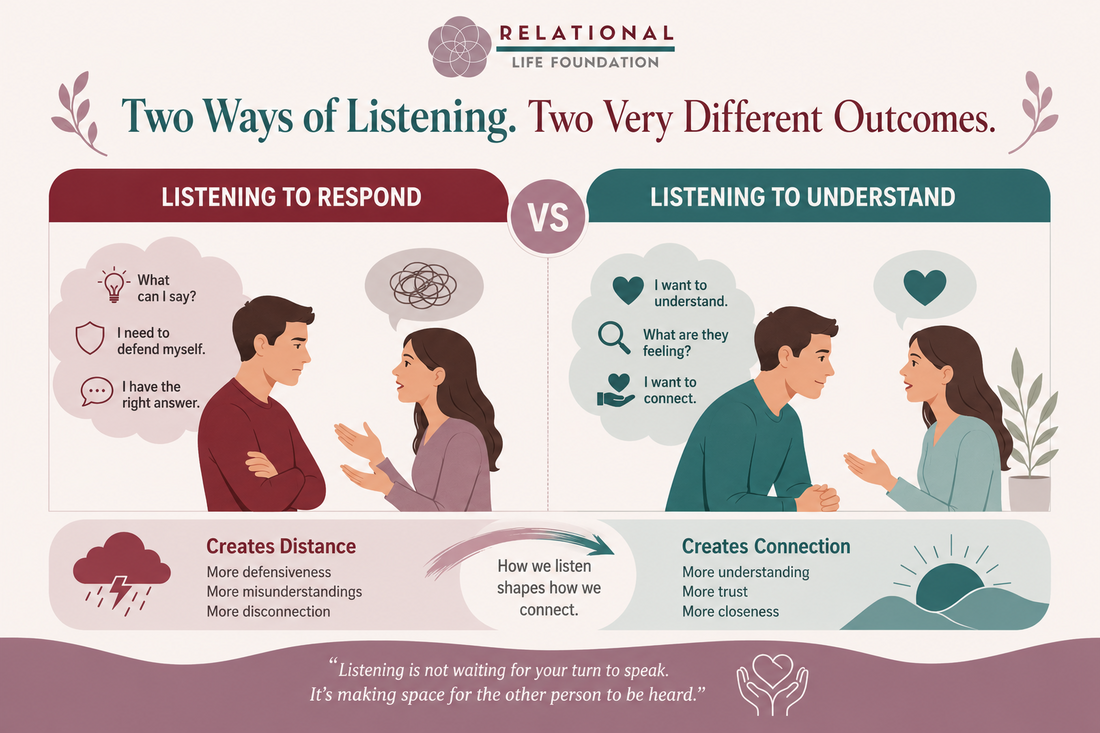
| Area of Difference | Listening to Respond | Listening to Understand |
| Main Focus | Focused on what to say next | Focused on fully understanding the speaker |
| Communication Style | Interrupts or reacts quickly | Pauses and stays curious |
| Attention | Listens for disagreement or defense | Listens for emotional meaning |
| Approach to Problems | Rushes into advice or solutions | Makes space for feelings first |
| Response Pattern | Tries to explain or justify | Tries to understand the experience and feelings |
| Emotional Impact | Can make people feel dismissed | Helps people feel emotionally safe |
| Relationship Dynamic | Prioritizes being right | Prioritizes connection |
| Conflict Outcome | Often increases defensiveness | Often reduces tension and conflict |
| Conversation Experience | Turns conversations into debates | Turns conversations into connections |
| Emotional Awareness | Hears the words only | Pays attention to emotions beneath the words |
| Example | “You’re overthinking this. Just calm down.” | “I can see this has been really heavy for you.” |
Taking It Further: “Strength is not the absence of vulnerability. Strength is knowing what your weaknesses are and working with them.” – Terrence Real
If you want to explore how emotional disconnection develops in relationships and learn more about building deeper intimacy, communication, and understanding, read the book How Can I Get Through to You?: Closing the Intimacy Gap Between Men and Women by Terrence Real.
Keep Reading:
How Does Patriarchy Affect Relationships?
How Relational Life Therapy Helps Individuals Speak Truth with Love?
How RLT Changes the Way You See Relationships
How Relational Life Foundation Supports Deeper Understanding in Relationships
When couples stop feeling emotionally heard, conversations can quickly become reactive, defensive, or emotionally distant. Over time, even small misunderstandings may develop into recurring patterns of conflict and disconnection.
At Relational Life Foundation, we offer Relational Life Therapy (RLT), developed by Terry Real, at sliding-scale rates for individuals and couples who want support navigating these patterns with more understanding, accountability, and connection.

Here are some ways this work can strengthen understanding between partners:
1. Learning to Slow Down Reactions
In many relationships, conflict escalates quickly because both partners react before truly listening. One person feels hurt, the other becomes defensive, and the conversation shifts into proving, explaining, or protecting.
RLT encourages people to slow these moments down instead of immediately reacting from emotion.
For example, instead of responding with:
“You always misunderstand me.”
A partner may begin practicing responses like:
“I want to understand why this felt painful for you.”
That pause creates more space for understanding instead of escalation.
2. Becoming More Curious About Each Other
Many people enter conversations focused on being understood, but healthy listening also requires curiosity about the other person’s emotional experience.
Relational Life Therapy teaches couples to move beyond surface-level arguments and explore what may be happening underneath the frustration, criticism, or silence.
This may sound like:
- “What’s been weighing on you lately?”
- “What did you need from me in that moment?”
- “What do you need from me in this moment?’’
- “I want to better understand what you were feeling when that happened.”
Curiosity often helps partners feel emotionally safer and more connected.
3. Staying Emotionally Present During Conflict
Difficult conversations can feel overwhelming, especially when emotions become intense. Some people withdraw emotionally, while others become louder, more reactive, or more defensive.
Relational Life Therapy places importance on slowing down, regulating emotions, and staying engaged in conversations long enough to truly understand what a partner is trying to communicate instead of reacting impulsively or avoiding discomfort.
This creates conversations where both people feel more emotionally heard and understood.
4. Understanding the Deeper Feelings Behind Conflict
Many recurring arguments are not really about the issue being discussed at the moment. Anger, criticism, or frustration are often connected to emotions like loneliness, rejection, hurt, fear, or a desire for closeness.
RLT encourages couples to pay attention to the emotional meaning connected to the conflict instead of reacting only to the words being spoken.
For example:
- “You never listen to me”
may actually mean:
“I miss feeling emotionally close to you.” - “You’re always busy”
may actually mean:
“I miss feeling important to you.”
When couples begin recognizing the emotions driving their reactions, conversations often become less defensive and more understanding-centered.
5. Practicing Accountability Without Shame
Listening becomes much harder when people feel forced to defend themselves constantly. One important part of relational healing is learning how to acknowledge impact without collapsing into shame or blame.
RLT teaches that accountability is not about humiliation. It is about staying open enough to recognize how your actions affected another person emotionally.
This can sound like:
- “I understand why that hurt you.”
- “I didn’t fully hear you earlier.”
- “I can see how my reaction affected you.”
Moments of accountability often create more trust and emotional closeness in relationships.
Check Out: How to Rebuild Trust in a Relationship Through Honesty
6. Creating More Connected Conversations
Over time, many couples fall into communication patterns that feel tense, repetitive, or emotionally distant. Conversations may begin revolving more around managing conflict than creating genuine connection.
Relational Life Therapy helps partners move away from defensiveness and toward more open, understanding-centered conversations.
Instead of conversations becoming cycles of interruption, blame, withdrawal, or defensiveness, partners begin practicing presence, empathy, curiosity, and emotional honesty together.
Conversations grounded in understanding and emotional honesty often help partners reconnect more deeply.
Contact Relational Life Foundation to take the next step toward building your relationship with a deeper understanding, healthier communication, and a stronger emotional connection.