


Relationships do not develop in a vacuum. The ways we communicate, trust, set boundaries, and respond to conflict are deeply influenced by the systems we live within. Economic instability, discrimination, unequal access to healthcare or education, and long-standing social hierarchies can all shape how people experience connection and safety in their relationships.

The effects of these broader social conditions often extend beyond workplaces, schools, or communities. They can influence how people navigate conflict, express emotions, build trust, and support one another in everyday relationships.
Let's explore how these inequalities can influence relationships and how Relational Life Therapy approaches can support healthier communication, connection, and relationship dynamics.
What Is Systemic Inequity?
Systemic inequity refers to unfair differences in access to opportunities, resources, and support that are created or reinforced by the systems people interact with every day. These differences can make it more difficult for some individuals and communities to access the same opportunities or outcomes as others.
Some examples of systemic inequities include:
- Unequal access to quality education or healthcare
- Employment discrimination and income disparities
- Limited access to affordable housing or stable neighborhoods
- Bias within healthcare, legal, or educational systems
- Social and cultural barriers that affect inclusion and opportunity
While these inequities are often discussed in the context of society, their effects can also extend into everyday life.
Learn How Identity Influences Communication and Connection.
Role of Power/Privilege in Systemic Inequities
Power refers to the ability to influence decisions, access resources, and shape outcomes, while privilege refers to advantages that can make access to opportunities, safety, and recognition easier for some people than others.
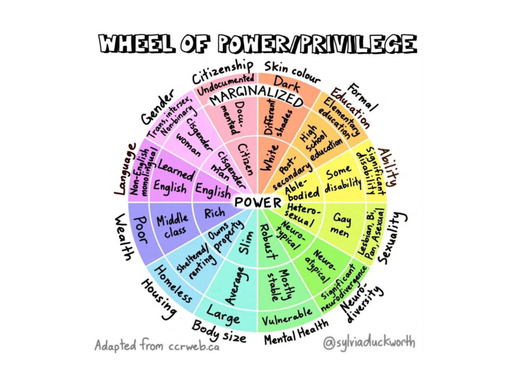
The Wheel of Power/Privilege helps illustrate how different aspects of identity and life experience can influence a person's position within society. Different aspects of identity can influence the level of access, support, or barriers a person may experience. These experiences are interconnected, allowing someone to hold privilege in one area while experiencing barriers in another.
| Area of Identity or Experience | Greater Power/Privilege | Greater Marginalization |
| Education | Greater access to education can create more opportunities and influence. | Limited access can create barriers to advancement and resources. |
| Wealth & Housing | Financial stability and secure housing can provide greater choices, safety, and support. | Financial hardship or housing instability can limit opportunities and increase vulnerability. |
| Race & Skin Color | Greater social acceptance and representation can reduce systemic barriers. | Experiences of bias or discrimination can affect access, recognition, and belonging. |
| Gender & Sexuality | Social acceptance can provide greater safety, visibility, and inclusion. | Discrimination or exclusion can create barriers to acceptance and equal participation. |
| Ability & Neurodiversity | Accessible environments can support participation and equal opportunities. | Lack of accessibility or support can limit inclusion and independence. |
| Language & Citizenship | Familiarity with dominant languages or secure citizenship can improve access to systems and services. | Language barriers or uncertain status can make accessing resources and opportunities more difficult. |
Understanding power and privilege helps understand why people may enter relationships with different experiences of safety, opportunity, and influence. These differences do not automatically determine relationship dynamics, but they can shape how individuals communicate, respond to conflict, and understand their own and others’ needs.
How Systemic Inequities Affect Relationships Through the Relationship Grid
To understand how power, privilege, and inequality shape relationship dynamics, Relational Life Therapy (RLT) uses the Relationship Grid to identify patterns of connection, conflict, and disconnection. While systemic inequities can widen relational power gaps, differences in upbringing, education, finances, culture, beliefs, personality, and life experiences can also influence how power is experienced.
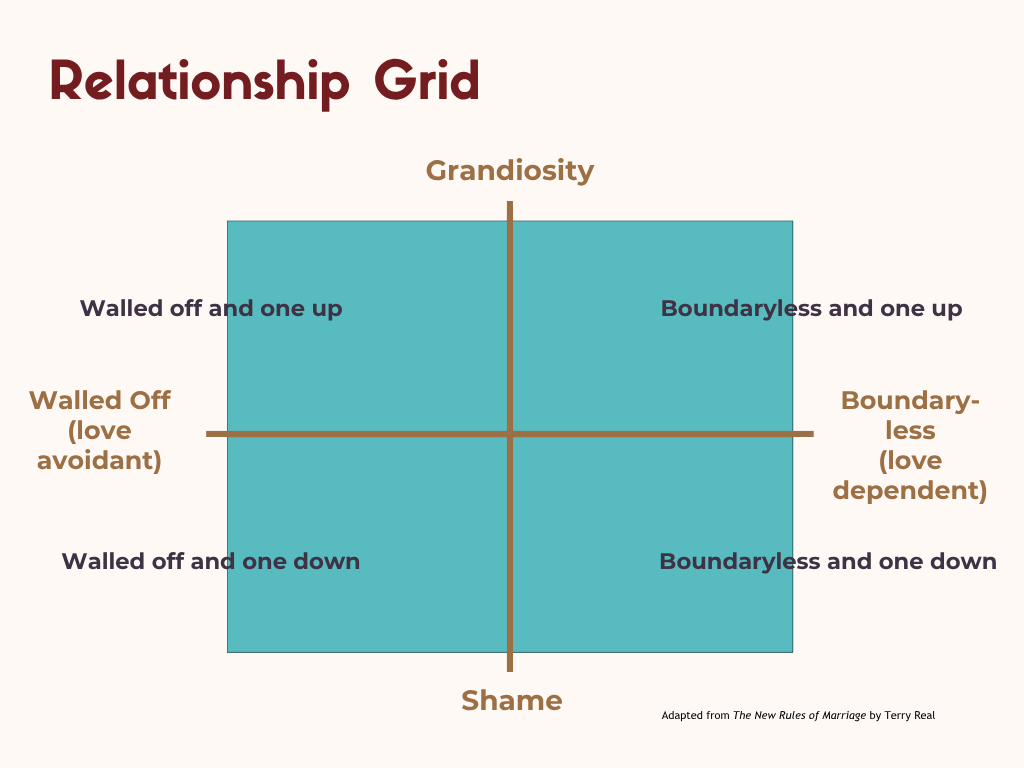
As these gaps grow, couples are more likely to move away from mutual respect and connection. In RLT, a common breakdown occurs when partners shift from Power With (equal partnership) to Power Over, where one partner assumes a position of superiority and the other feels diminished. https://www.relationallifefoundation.org/relationship-grid-survey.html
The Relationship Grid helps recognize these patterns before they become deeply established. Evaluating a relationship through the Grid often reveals two common defensive positions:
The "One-Up" Position (Grandiosity)
The One-Up position reflects a Power Over stance, where one person begins to see their needs, opinions, or perspective as more important than their partner's.
In everyday relationships, this may look like:
- Dismissing a partner's feelings or perspective
- Making important decisions without collaboration
- Believing one's own needs or opinions should take priority
- Responding defensively instead of listening during conflict
Although these behaviors may create a temporary sense of control or certainty, they often weaken trust, mutual respect, and emotional intimacy.
The "One-Down" Position (Shame)
The One-Down position reflects the opposite side of the relational imbalance, where a person begins to see themselves as less important, less capable, or less worthy than their partner.
In everyday relationships, this may look like:
- Staying silent to avoid conflict
- Believing their opinions or feelings matter less
- Constantly seeking approval before making decisions
- Withholding needs out of fear of rejection or criticism
When couples experience external stress, they don't always respond in the same way. One partner may withdraw emotionally, while the other becomes more controlling or reactive. These different responses can create cycles of misunderstanding and conflict, even when both partners are trying to cope with the same external pressures.
Viewing these interactions through the Relationship Grid helps people recognize that many difficult relationship behaviors are protective responses developed during stress. Rather than seeing each other as the problem, couples can begin to understand the underlying patterns influencing their relationship and work toward healthier ways of relating.
How RLT helps couples recognize and address these imbalances
1. Honest Confrontation of Power Imbalances

When external factors give one partner more influence, such as higher earning power, greater social privilege, or fewer caregiving responsibilities, that imbalance can carry into everyday interactions. Over time, it may shape how decisions are made, whose needs are prioritized, or whose perspective carries more weight.
To help couples recognize and address these hidden dynamics, RLT encourages loving confrontation. By acknowledging how unequal power may be affecting the relationship, both partners can better understand its impact and begin working toward greater mutual respect, shared responsibility, and healthier ways of relating.
2. Transitioning to Radical Fierce Intimacy
Many individuals experiencing systemic inequities develop a state of hyper-independence ("I can only rely on myself"). While this is a brilliant survival mechanism for the outside world, it prevents vulnerability at home.
RLT helps couples move beyond this protective wall through Radical Fierce Intimacy, the courage to speak the absolute truth about systemic exhaustion and pain, while simultaneously staying warmly connected.
3. Prioritizing Relational Repair Over Perfection
Ongoing external stress can place strain on even the strongest relationships. Without opportunities to address misunderstandings and unresolved emotions, they can build over time, making it harder for partners to feel supported and understood.
RLT emphasizes relational repair as an essential part of maintaining a healthy relationship. Rather than expecting couples to avoid conflict or get everything right, RLT helps them acknowledge hurt, take responsibility for their impact on one another, and intentionally rebuild trust after difficult moments.
Note: Recently, Relational Life Foundation's RLT therapists, Beverly Joy Ehrlich and Sima Menora, discussed the importance of relational repair. Watch the full conversation to learn how repair can help strengthen relationships and rebuild connection after conflict.
Taking it further: “The difference between real acceptance and just backing away from an issue – or away from the whole relationship – is resentment.” – Terrence Real
If you're looking to better understand the patterns that create distance in relationships and learn practical ways to build deeper connection, Terry Real's book How Can I Get Through to You?: Closing the Intimacy Gap Between Men and Women is a valuable resource.
Related Articles:
How Does Patriarchy Affect Relationships?
How to Handle Grandiose Behavior in Relationships
Why Building Healthy Relationships Matters in a Diverse Cultural Society?
Build Healthier Relationships with Relational Life Foundation
To help individuals, couples, families, and communities access the principles of Relational Life Therapy, Relational Life Foundation offers RLT sessions at a sliding scale.
Founded on Terry Real's RLT approach, we are dedicated to helping people build healthier, more connected relationships through education, training, and community-based learning opportunities. Whether you're navigating ongoing conflict in a relationship, experiencing tension within your family, or feeling the emotional impact of societal discrimination and other life challenges, we are here to support you.
You can contact us to learn more about our programs and resources, or explore our relationship guides to gain practical insights that you can apply in your everyday relationships.